
Views: 0 Author: Site Editor Publish Time: 2026-08-04 Origin: Site
Bringing a newborn home involves countless unknowns. Diapering supplies should never be one of them. Expectant and new parents need predictable inventory forecasting to avoid late-night shortages without overspending on supplies that might dry out. Miscalculating these essentials often leaves parents frustrated. You might find empty dispensers at the worst possible moment. Conversely, you might stare at towering boxes of unused supplies taking up precious closet space.
Total usage depends heavily on several factors. We must consider the baby's age, dietary stage, and the structural quality of the chosen product. Every child develops differently. Sensitivities can emerge unexpectedly. A wipe brand working perfectly today might cause a rash next month.
We aim to provide a data-backed baseline for consumption. You will learn smart purchasing strategies, comparing bulk buying against flexible subscriptions. Finally, we will define clear criteria for selecting the most efficient products. This guide helps you navigate diaper changes with confidence and cost-efficiency.
Newborn Baseline: Expect to use roughly 200–300 baby wipes per week during the first three months (based on 8–10 diaper changes daily).
Quality Impacts Quantity: Thicker, textured wipes lower the "burn rate" by requiring fewer sheets per heavy-duty cleanup.
Trial Before Bulk: Avoid stockpiling months of a single brand before birth; sensitivities often dictate a brand switch in the first few weeks.
Inventory Management: Subscription models often provide better cost-efficiency and freshness than hoarding bulk boxes that risk drying out.
Establishing a standard consumption model helps calculate monthly recurring costs. You cannot manage your household budget effectively on guesswork alone. Many parents severely underestimate how frequently babies require cleaning. We break down the estimated usage by developmental stage to give you a reliable forecast.
The Newborn Stage (0–3 Months)
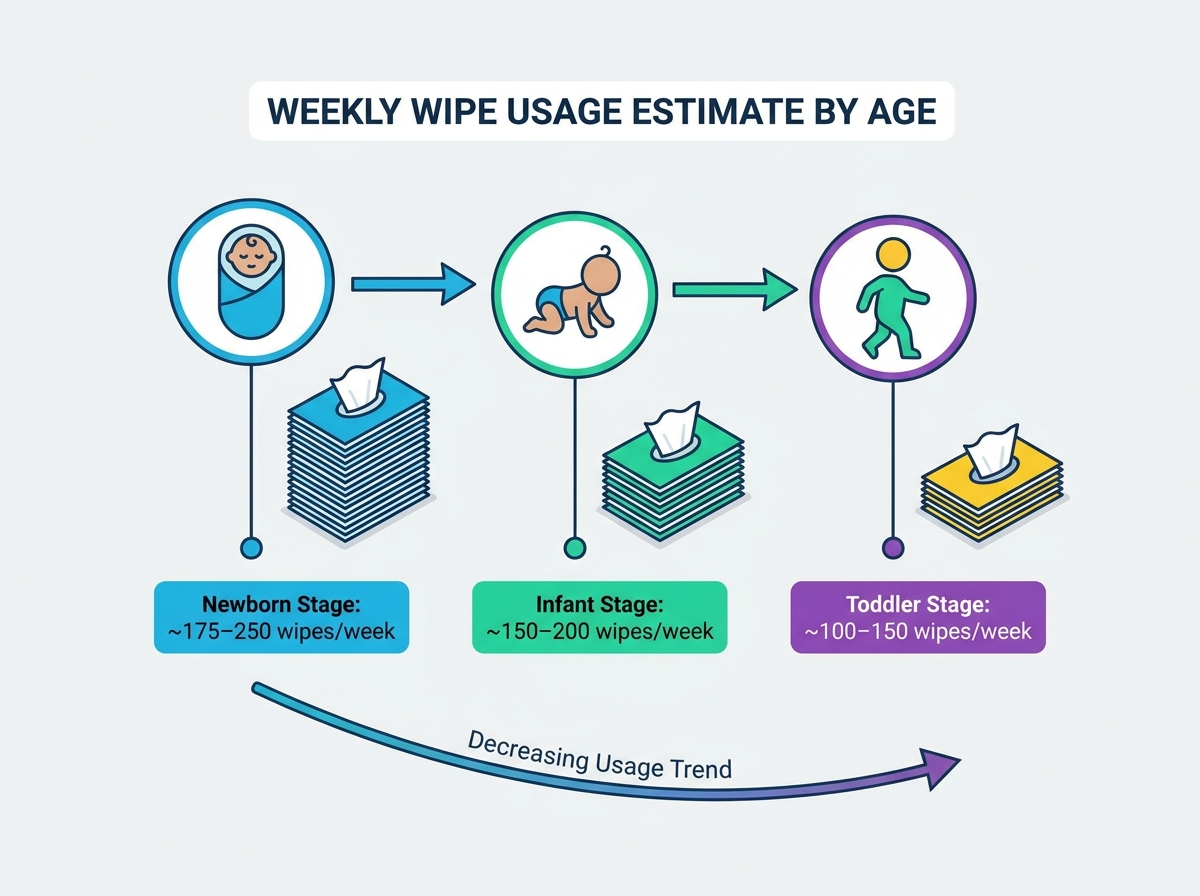
Newborns process milk or formula rapidly. They require frequent attention around the clock. You can expect an average of 8 to 12 diaper changes per day. Parents typically use an estimated 2 to 3 sheets per change. Frequent liquid stools often demand extra cleaning. Forecast: You will likely use 175 to 250 sheets per week. This equals approximately 3 to 4 standard packs.
The Infant Stage (4–11 Months)
As digestion matures, daily diaper changes decrease to roughly 5 to 8 per day. However, this stage introduces solid foods. Purees and mashed foods create entirely new messes. Usage expands rapidly. You will start cleaning hands, faces, highchairs, and floor spills. Forecast: Plan for 150 to 200 sheets per week.
The Toddler Stage (12+ Months)
Toddlers require even fewer diaper changes. Most average 4 to 6 per day. Despite this drop, overall usage remains steady. Active toddlers explore the world aggressively. They touch dirt, paint, and sticky foods constantly. Baby Wipes transition into a general hygiene tool for mess management. Forecast: Expect to use 100 to 150 sheets per week.
Trust Indicator: Please note these figures represent statistical averages. Gastrointestinal phases, illnesses, and developmental milestones cause week-to-week fluctuations. Teething often leads to softer stools, temporarily spiking your daily usage.
Estimated Weekly Usage by Age Group
Age Group | Average Daily Changes | Estimated Sheets Per Change | Total Weekly Forecast |
|---|---|---|---|
Newborn (0-3 Months) | 8 - 12 | 2 - 3 | 175 - 250 |
Infant (4-11 Months) | 5 - 8 | 1 - 3 (plus feeding cleanup) | 150 - 200 |
Toddler (12+ Months) | 4 - 6 | 1 - 2 (heavy hygiene use) | 100 - 150 |
Identifying the operational realities disrupting standard consumption formulas is critical. Real life rarely follows neat mathematical models. Several hidden variables accelerate how quickly you empty a package.
Wipe Thickness and Efficacy
Thickness matters immensely. Thin, low-cost sheets often tear or fold during use. Parents compensate by grabbing handfuls. You might require 4 to 5 thin sheets for a mess. A premium, thick alternative handles the same mess in 1 to 2 sheets. Assessing density helps you predict actual consumption rates. High-quality Baby Wipes often feature denser weaves, minimizing the risk of tearing.
Skin Sensitivities and Medical Realities
Babies possess highly delicate skin barriers. Diaper rash or eczema strikes frequently. These conditions may require switching to specialized water-based options immediately. Such products often feature different moisture retention levels. They might dispense differently than standard versions. Coping with sensitive skin often means applying gentler, less efficient strokes. This habit subtly increases the total sheet count per change.
Dispenser Mechanics
Few things frustrate parents more than "chaining." You pull one sheet, and three more follow in a long rope. Packages causing chaining artificially inflate usage rates. In a sleepy, late-night state, you rarely push the extras back into the pack. They dry out and end up in the trash.
Best Practice: Always test the dispensing mechanism before buying a bulk case. Look for packages offering precise, single-hand dispensing.
Common Mistake: Rushing to wipe off dried messes. Pressing a damp cloth over a dried mess for five seconds loosens it, saving you multiple sheets.
We must move beyond price-per-pack metrics. Assessing true value and safety compliance requires a deeper look at materials and ingredients. Not all hygiene products perform equally. Here is how to evaluate your options effectively.
Material & Texture Analysis
Look closely at the fabric surface. You want embossed or textured plant-based fibers. Flat, smooth sheets tend to smear messes across the skin. Textured patterns grip soils effectively. They lift dirt away cleanly. Plant-based materials also offer superior softness and better environmental profiles.
Ingredient Transparency (Compliance/Safety)
Evaluate the necessity of 99% water formulations versus those containing mild, dermatologically tested cleansers. Pure water formulas suit newborns beautifully. However, as infants grow and diets change, mild cleansers break down grease and heavy soils better.
Watch out for industry red flags. You must avoid undisclosed fragrances. Steer clear of parabens and harsh preservatives like methylisothiazolinone (MI). These chemicals often trigger contact dermatitis in young children.
The "Cost Per Change" Metric
Do not judge affordability purely by the retail price. You need a framework for calculating true return on investment (ROI). Consider the "Cost Per Change" metric. A $0.05 premium sheet used twice per change costs $0.10 total. A $0.02 budget sheet used six times per change costs $0.12 total. The ostensibly more expensive product actually saves you money and reduces physical waste.
Deciding how to procure and manage inventory without creating waste requires strategy. Many parents fall into common retail traps. We can categorize solutions into two main approaches: bulk hoarding and flexible subscriptions.
The Risk of Early Stockpiling
Adding 10 boxes of a single brand to a baby registry seems logical. It is actually a high-risk strategy. Newborn skin reacts unpredictably. If your child develops an allergic reaction to that specific brand, those 10 boxes become useless. Furthermore, stockpiling risks products drying out before you even open them.
When Bulk Buying Makes Sense
Bulk buying is not inherently bad. It simply requires the right timing. It works best for parents with toddlers. By this stage, you have established a clear brand preference. The child’s skin sensitivities are well-known. Bulk buying also requires adequate, climate-controlled storage space to protect the product integrity.
The Subscription Advantage
Subscription models solve many modern parenting headaches. They ensure maximum moisture integrity. Your products have not sat in a hot warehouse for a year. Subscriptions also allow easy pivoting. You can switch between different sizes or types as the baby grows. Most importantly, automating this purchase eliminates the cognitive load. You never have to monitor inventory levels or make emergency midnight pharmacy runs.
Protecting your investment involves proper storage habits. Environmental factors degrade hygiene supplies quickly. Learning basic risk management extends the lifespan of your supplies.
Do They Expire?
Yes, they do expire. Understanding manufacturer shelf-life guidelines prevents skin irritation. Unopened packages typically last 12 to 24 months. Preservatives break down over time. Using expired products exposes delicate skin to potential bacterial growth or fungal contamination.
Moisture Retention Tactics
Gravity plays a huge role in moisture distribution. We recommend storing unopened boxes upside down. This simple tactic ensures the topmost sheets are heavily saturated when you finally open the package.
We must also address aftermarket wipe warmers. They sound luxurious, but they cause problems. Constant heat accelerates the dry-out process. Furthermore, warm, dark, and moist environments create perfect breeding grounds for bacteria. If you use a warmer, only load enough sheets for a single day.
Salvaging Dry Packages
Accidents happen. Someone leaves the plastic lid open overnight. The top layer dries out completely. Do not throw the package away. You can utilize practical, safe methods to rehydrate them. Pouring a small amount of distilled water into the package often restores functionality. Avoid using standard tap water. Tap water introduces unpurified minerals and potential microbes into an otherwise sterile environment.
Here are a few quick tips for managing waste effectively:
Keep packages away from direct sunlight or heating vents.
Ensure the plastic snap-lid clicks audibly after every use.
Repurpose partially dried sheets for dusting baseboards or wiping muddy stroller wheels.
Estimating your diapering needs does not require complex calculus. You simply need a reliable decision framework. Start with a modest supply of high-quality, sensitive-skin-friendly supplies for the newborn phase. Observe how your baby reacts before committing to large volumes.
Remember, structural quality matters. Investing in a superior, textured sheet significantly reduces the overall volume needed. You wipe less, you spend less, and you irritate the skin less.
As a next step, we strongly recommend starting with a one-month trial or a flexible subscription box. Avoid committing to a massive bulk purchase on day one. This flexible approach protects your budget and ensures you always have fresh, effective supplies on hand.
A: Keep it conservative. Ask for 2 to 3 multipacks of varying brands. This allows you to test different textures and moisture levels without committing heavily. Once you determine which brand suits your baby's skin best, you can begin purchasing in larger quantities.
A: Yes, dermatologists generally recommend water-only or highly purified formulations for the first few months. Newborn skin is highly permeable and prone to irritation. As your baby transitions to solid foods, you may switch to mildly cleansed formulas to handle tougher messes.
A: It is not ideal. These products contain skin-safe cleansers and conditioning agents designed for the body. They leave a subtle residue. They are not surface disinfectants. If a pacifier falls, wash it with warm water and soap rather than using a diaper wipe.
A: Wipe warmers apply constant, direct heat. This accelerates evaporation mechanics. Moisture escapes through tiny gaps in the dispenser. To prevent this, only place a one-day supply in the warmer at a time, or add a few drops of distilled water occasionally.


